
For years, personal cloud has been judged too narrowly. It has often been positioned as a safe place to store photos, videos, and digital memories, but not always as a place that actively creates new value for the subscriber. That is changing. With Genius, Synchronoss is taking a major step forward by turning the cloud into a more intelligent, more engaging, and more emotionally relevant experience for both operators and consumers.
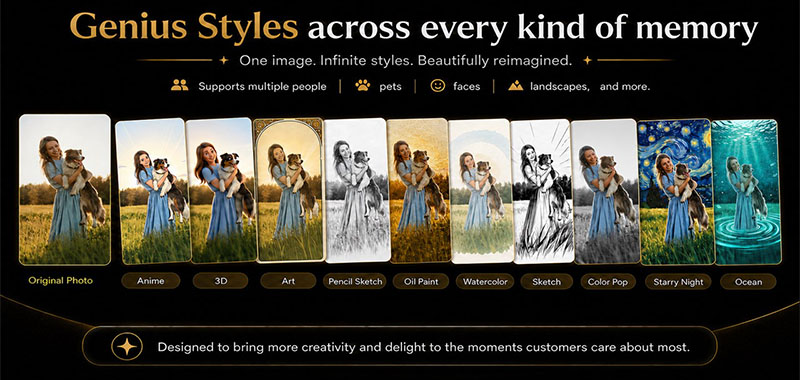
At its core, Genius is simple in the best possible way. It applies AI-powered transformations to a subscriber’s existing photos rather than asking them to learn a prompt language or create something from scratch. Internal product positioning around Genius has consistently emphasized one-tap creativity, fast style exploration, and the ability to transform an existing photo into anime, art, color pop, 3D, sketch, and other stylized looks in seconds. The latest Genius update should be understood as a major improvement to the existing Genius experience, not the launch of an entirely new set of capabilities.
Across the core Genius categories of Styles, Cartoons, and Smart Editor, and with the exception of Upscaler, we have updated the underlying models to materially improve quality and remove prior limitations. That includes eliminating earlier constraints around faces and multiple people, extending the experience to pets, and improving output quality across family photos, group shots, portraits, and other everyday memories. The update also strengthens specific parts of the experience, including improved cartoon styles and better Smart Editor results in tools such as Colorizer and Image Repair. In short, this is about making the Genius experience people already know work much better, across more kinds of images, without forcing a new workflow on operators or consumers.
That matters because the most compelling AI experiences are not the ones that feel like work. They are the ones that remove friction, create delight quickly, and make the user want to come back. Your existing Genius framing captures that well: the system can proactively surface strong candidate photos, let users instantly try different styles, and create “wow” moments that encourage sharing, repeat usage, and stickiness. For consumers, that means less time organizing and editing and more time enjoying the result. For busy families, it means favorite memories can be reimagined, personalized, and made more fun without any creative barrier to entry.
For operators, the value is even bigger than feature novelty. Genius is not just another AI demo. It is a practical way to increase engagement, create more repeat opens, deepen usage across the photo experience, and build new monetization paths over time. Internal strategy documents tie Genius directly to a business arc of personalization to engagement to sharing to retention to print revenue, making clear that this capability should be viewed as a growth engine rather than a point feature.
That growth story becomes particularly powerful when Genius is connected to the rest of the cloud journey. Product planning has already focused on stylized memory flows that can deep-link into Genius from notifications, encouraging users not just to view content but to act on it, save it, share it, and return for more. Separate analytics work has been designed to measure exactly that funnel, extending beyond standard memory engagement to track notification opens, Genius opens, and Genius saves so operators can quantify the incremental impact of stylized experiences on engagement and retention.
This is an important shift. Too often, cloud value has been framed in defensive terms: backup, protection, and retrieval. Those remain essential, but they are no longer enough on their own. Subscribers respond to experiences that feel personal and alive. Genius helps operators move from passive storage to active engagement by giving subscribers new reasons to open the app, revisit their content, and share what they create. In other words, it turns the content already in the cloud into a renewable source of value.
There is also a strategic reason this approach works well now. Genius is grounded in a user’s own photos, which makes the experience inherently more personal, more relevant, and often more trusted than generic AI generation. Internal documentation explicitly describes Genius as a transformation layer on existing images rather than arbitrary text-to-image creation. That distinction is valuable for operators because it supports a safer, more consumer-friendly AI story: one rooted in enhancing personal memories, not replacing them.
At the same time, Synchronoss has been thoughtful about the responsibility that comes with AI. Just as important as the experience itself is the way we handle customer content. Unlike many big tech AI models, we do not train Genius on an end user’s personal photos or expose that personal content to others. That is a critical distinction for operators looking to bring AI innovation to market without compromising trust, privacy, or brand integrity. Our approach is grounded in a clear principle: deliver AI value while keeping personal content protected and private. For executives evaluating AI investments, this matters. The winning AI products will not only drive engagement; they will do it in a way that is responsible, explainable, and aligned to the trust expectations operators and consumers now demand.
This is where Genius stands out. It gives operators a modern AI story they can bring to market now. It creates immediate consumer delight through stylized photo transformations and smart enhancement tools. It creates measurable business value through more opens, more saves, more sharing, and stronger re-engagement paths. It opens future monetization opportunities through print, gifting, and adjacent premium experiences built on transformed or curated content. And it does all of that while staying connected to the trusted content subscribers already have in the cloud.
The bigger point is this: AI in personal cloud should not be treated as a side experiment. When done right, it becomes a core part of the operator value proposition. It strengthens the emotional relevance of the cloud experience for consumers, and it strengthens the commercial relevance of the platform for service providers. Genius is an example of that model in action. It helps subscribers see their memories in new ways, and it helps operators turn a utility into an experience people actually want to return to.
That is the opportunity ahead. The future of personal cloud will not be defined only by how well it stores content. It will be defined by how intelligently it activates that content to create delight, engagement, retention, and long-term growth. With Genius, Synchronoss is showing what that future can look like.